Conference Room
How to Plan a Half-Day Offsite Meeting in Fullerton—Sample Agenda Included
Published Last updated 6 min read
Your team doesn’t need a three-day retreat to make progress. Sometimes, it needs four focused hours—and a plan.
A half-day offsite meeting takes your team out of its usual workspace to work on one important question. For a small business, that might mean choosing next quarter’s priorities, fixing a slow client handoff, or agreeing on a launch plan. The goal is not to squeeze a full retreat into a morning. It is to leave with decisions people can act on.
Here is a practical four-hour agenda, a preparation checklist, and a follow-up template you can adapt for a team meeting in Fullerton.
Start with one decision, not a list of presentations
Before reserving a conference room, finish this sentence: “By the end of this meeting, we will decide…”
“Discuss growth” is too broad. “Choose three changes that will help us respond to new inquiries faster over the next 90 days” gives the team a useful boundary. Write down what is outside the scope, too. A conversation about inquiry response times does not have to become a complete website redesign.
Invite the people who understand the problem, will do the work, or can approve the decision. For this agenda, a small group of four to eight is a practical starting point. Name a facilitator, a note-taker, and the person who will make the final call if the group cannot agree. One person can hold more than one role.
Send this preparation checklist 48 hours before the meeting
- The decision question: one sentence everyone can understand.
- A short pre-read: one page of relevant numbers, customer feedback, or project updates—not a new slide deck from every attendee.
- One idea per person: ask each attendee to bring a specific obstacle and a possible improvement.
- The ground rules: stay on the decision question, keep unrelated topics on a separate list, and agree when phones and laptops are needed.
- Arrival details: address, parking and entry instructions confirmed with the venue, start and finish times, and an organizer’s contact number.
- Equipment and access needs: check display connections, adapters, seating, and any attendee accessibility requirements before booking.
If someone will join remotely, confirm the audio and camera arrangement separately. A room with a display and Wi-Fi does not necessarily include a video-conferencing camera or microphone.
A four-hour offsite meeting agenda you can copy
This example runs from 9:00 a.m. to 1:00 p.m. and includes arrival, a break, and packing up. Shift the times to fit your reservation. If your setup needs more than a few minutes, book additional time rather than assuming early access is included.
- 9:00–9:15 | Set up and define success. Connect the laptop, open the shared notes, and read the decision question aloud. Confirm the outcome, roles, and finish time. Leave this segment with a clear boundary for the discussion.
- 9:15–9:45 | Establish the facts. Review the pre-read and distinguish what you know from what you still need to verify. Keep updates short. Leave with a shared description of the problem, not competing presentations.
- 9:45–10:30 | Identify the biggest obstacles. Give everyone a few quiet minutes to write, then share ideas in turn. Group related issues on the whiteboard. Leave with a short list of obstacles the team can realistically influence.
- 10:30–10:45 | Take a break. Allow time for coffee, water, and urgent messages. Keep the restart time visible.
- 10:45–11:45 | Choose up to three priorities. Compare possible actions by likely impact, effort, and dependencies. Voting can surface preferences, but the designated decision-maker should resolve trade-offs. Leave with three priorities or fewer and a brief reason for each.
- 11:45–12:45 | Turn decisions into an action plan. Assign one owner to each action, define a concrete deliverable, and set a due date. Check capacity and dependencies before people commit. Leave with a plan that can be copied into the team’s existing project tool.
- 12:45–1:00 | Read back, schedule, and pack up. Confirm commitments aloud, schedule a short check-in for the following week, save the notes, and clear the room before the reservation ends. Capture whiteboard notes only if doing so is appropriate for the information discussed.
Use a simple action-plan template
Copy this into your shared document and repeat it for each agreed action:
Decision: What did we agree to do?
Reason: Why is this a priority now?
Owner: Who is accountable?
Deliverable: What will be completed?
Due date: When will it be ready?
Dependency: What input or approval is needed?
First check-in: When will we review progress?
For example, “Improve follow-up” is a wish. “Alex will draft three inquiry-response templates for team review by Friday” is an action. Keep the plan small enough to fit the team’s actual workload.
Choose a Fullerton meeting room that supports the work
For this type of offsite, focus on the basics: enough seats, a display for the shared document, a whiteboard for sorting ideas, and reliable Wi-Fi. Ask about the full reserved time and total price, including any applicable fees, before committing.
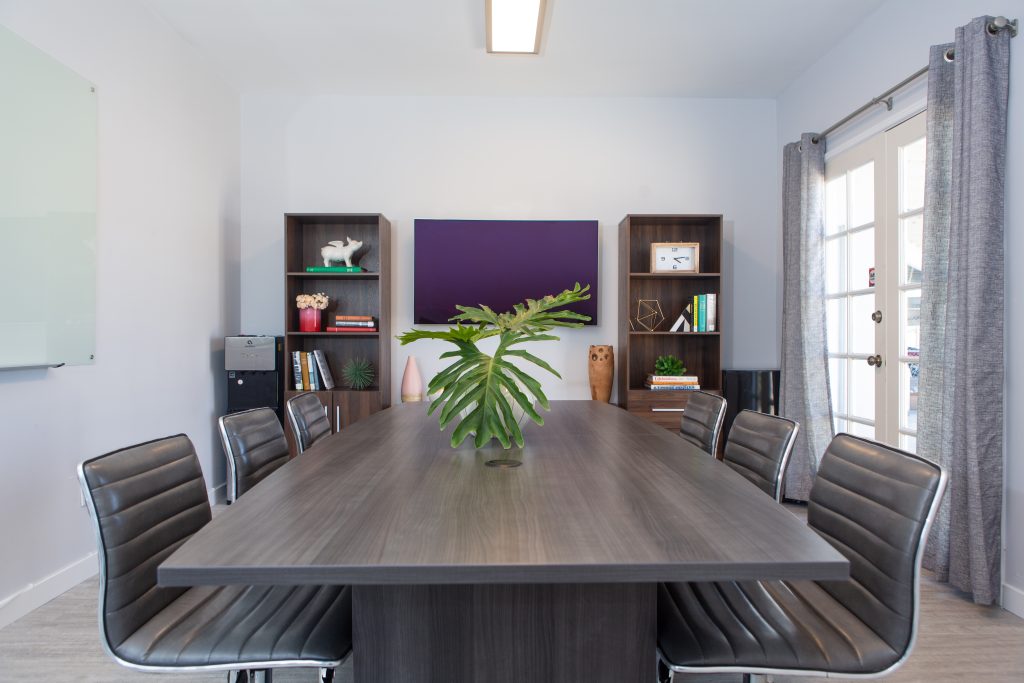
ZworkSpace’s conference room in Fullerton seats up to eight and has hourly pricing starting at $50. The room includes fast Wi-Fi, a wall-mounted display with HDMI connectivity, a whiteboard and markers, and complimentary coffee and water. Evening and weekend reservations are subject to availability.
ZworkSpace is at 1303 W Valencia Drive, Fullerton, CA 92833. Confirm availability, your preferred layout, display compatibility, arrival instructions, and current booking terms with the team. The agenda above is a planning example, not a separately priced half-day package.
Keep the momentum after everyone leaves
Send the decision summary within one business day. Include the priorities, owners, due dates, and unresolved questions. Do not send only a photograph of a busy whiteboard and expect everyone to interpret it the same way.
At the following week’s check-in, ask three questions: What is done? What is blocked? What decision or support is needed next? If the offsite produced more work than the team can handle, change the plan deliberately instead of letting deadlines quietly slip.
Frequently asked questions
Is four hours enough for a team offsite?
Four hours can be enough for one well-defined problem and a small group that prepares in advance. It is less suitable for a full annual strategy review, extensive training, or several unrelated decisions. Narrow the scope or reserve more time.
Do we need a full-day retreat venue?
Not necessarily. If your team needs a focused working session without overnight stays or a large event program, an hourly conference room may fit. Check the room’s capacity, equipment, access, and reservation terms against your agenda.
Should lunch be part of a half-day meeting?
It is optional. This sample ends at 1:00 p.m., so a team lunch can happen afterward. If food will be served during the reservation, confirm the venue’s food policy and allow time for setup and cleanup.
Ready to give your team four focused hours?
Start with the decision question and invite the people needed to answer it. Then contact ZworkSpace about conference-room availability with your preferred date, time block, attendee count, and equipment needs. A clear purpose, a suitable room, and a short action plan are a strong starting point for your next Fullerton team offsite.